
Morton County Scheduled and Actual Release
A projected date is an estimate based on sentence facts known to the agency. Actual release is the later custody event. The dates can differ without either record being false. A court order, credit adjustment, disciplinary forfeiture, hold, or transfer may change what happens. Leaving Morton County custody for KDOC or another jail is not release to the community.
Kansas uses several labels. KASPER may show KDOC's exact field, “Anticipated Release Date.” Parole eligibility is an opportunity for Board review, not a promised exit. Conditional release, postrelease supervision, maximum sentence date, and sentence discharge are separate milestones.
Find a Morton County Projected Release Date
No one database covers all Morton County release dates. A pretrial detainee may have no set date. Bond, dismissal, a court order, or a new hold controls that stay. A local sentence requires the judgment, jail credit, and Sheriff record. A state-prison date belongs to KDOC.
- Call the Sheriff at 620-697-4313 for local custody and ask whether the person is held, released, or transferred.
- Check the Morton County case for bond, sentence, jail credit, or a corrected order.
- For a state sentence, open KASPER and match identifiers.
- Read “Anticipated Release Date” only when it appears, along with location and sentence events.
- For a missing or disputed state date, contact the KDOC Sentence Computation Unit at 785-296-3317.
KASPER does not prove each county booking. A Sheriff transfer entry shows when local custody ended; KASPER intake shows continued state custody. The Morton County release search explains how to reconcile those records.
Kansas Credits Shape Morton County Dates
Kansas has no universal rule that each person serves the same percentage. KDOC describes determinate-sentence good time at 15 or 20 percent depending on offense date and category. The 15 percent ceiling yields the shorthand that some people serve about 85 percent of the prison portion when all credit is earned and kept. That shorthand is not a formula for every case.
K.S.A. 21-6821 is the core guidelines-credit statute. It includes a general 15 percent maximum for covered offenses, specified 20 percent groups, and up to 120 days of eligible program credit. Credit can be withheld, forfeited, restored, or adjusted. The offense date and judgment control.
For indeterminate terms, KDOC says good time may be earned at 50 percent, affecting parole eligibility and conditional release. K.S.A. 22-3717 addresses parole, conditional release, and postrelease. Do not apply these prison percentages to a county-jail term. No Morton County jail credit or weekend-release policy was located.
Why Morton County Release Dates Change
Sentence computation has many inputs. Trace a change to an official order or agency record instead of guessing from the headline term.
| Factor | Effect | Source |
|---|---|---|
| Jail-credit correction | Moves remaining time | Court and computation record |
| Concurrent or consecutive terms | Changes combined term | Journal entries |
| Good-time or program credit | May reduce time | KDOC |
| Credit forfeiture | May delay date | KDOC |
| Corrected judgment | Changes sentence | Court |
| Detainer or warrant | May cause transfer | Both custodians |
| Board action | Grant, pass, or continue | PRB and KASPER |
A “time served” entry can satisfy the Morton case while another hold continues custody. The court explains the basis; the Sheriff supplies the door event and destination.
Confirm a Morton County Release Date
KASPER covers KDOC incarceration, supervision, and discharge, is not a full criminal history, and updates on working days. Review the official KASPER disclaimer before relying on a result.
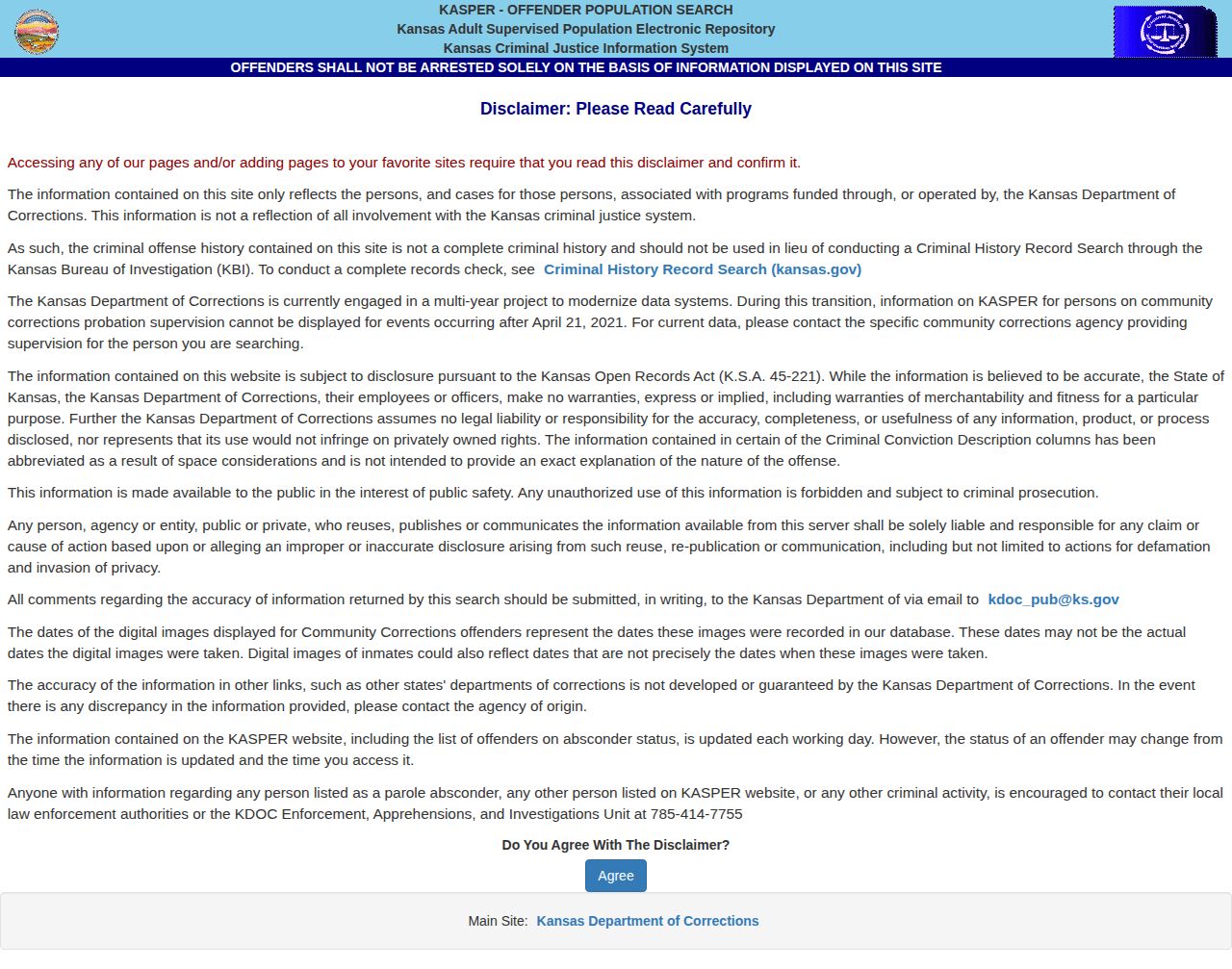
The entry establishes scope and timing limits. If KASPER says parole or postrelease, prison custody ended while supervision continues. “Discharged” means the KDOC obligation ended.
For Morton County jail proof, submit a narrow Kansas Open Records Act request. Identify the person, booking period, and Law Enforcement Center. Ask for the existing admission and release entry, release reason, authority, date and time, and destination. Request electronic copies and a cost estimate. No local fee, retention period, release hour, or weekend rule was published.
Morton County Jail and KDOC Dates
The Morton County Sheriff and KDOC compute different kinds of stays. A short local sentence is controlled by the court's order, recorded jail credit, and any law that applies to that term. KDOC computes a state sentence after intake. One office cannot confirm the other office's final date.
A county release may also lead straight to another custodian. Ask whether the person entered the community or transferred. For KDOC, use the Sentence Computation Unit when a public field is missing. For a federal sentence, use the BOP locator. Kansas VINE concerns participating county-jail custody and expressly excludes KDOC prisoners.
When a date arrives from a notification, save its agency and event wording. A release, transfer, escape, parole-effective date, and discharge date are not the same. Confirm urgent events with the named custodian.
Morton County Court Date Evidence
The Kansas District Court Public Access Portal can show case number, parties, hearing dates, and docket events. Public documents may add the complaint, plea or verdict, journal entry, sentence, probation order, revocation, dismissal, or satisfaction. Portal case information is not always the full official document. A public item missing online may be available at the courthouse terminal or from the Clerk of the District Court.
Morton County lies in the 26th Judicial District. The district court handles Kansas criminal jurisdiction, while Elkhart Municipal Court handles city-ordinance matters. The agency that booked the person does not by itself identify the right court. Start from the cited charge or case number. For a district matter, the Morton County Clerk can be reached at 620-697-2563.
A journal entry establishes the legal sentence or order. It can record jail credit, concurrent or consecutive terms, probation, or time served. Still, its filed time is not automatically physical release time. Pair it with the Law Enforcement Center event. If the two dates differ, retain each label rather than forcing them into one “release date.”
Morton County Parole Date Limits
The KDOC Prisoner Review Board performs Kansas parole-board functions. Its public-comment calendars and offender lists show people approaching consideration, not people guaranteed to leave prison. A public-comment session can precede the eligibility hearing, and a possible release may occur later. The Board can grant parole, issue a pass for later consideration, or continue a case for more information.
Many post-July 1993 determinate sentences do not use traditional parole review, apart from specified offenses. Older indeterminate terms and special categories follow their governing statute. A date on a Board calendar should never replace the KASPER status, effective decision, and later custody event.
Morton County may appear as county of conviction on a public list, but that does not show the person's prison location or intended home. Conversely, someone released to Morton County can have a conviction elsewhere. Filter and describe those facts separately.
Older Morton County Release Dates
For an older county stay, begin with the case docket and a written Sheriff request. No online retention window was published. Ask whether an archived jail-management entry exists for the date and whether another custodian holds it. KORA does not create a fixed retention period by itself.
KASPER can retain records for people in the Secretary of Corrections' custody since 1980 who are incarcerated, supervised after prison, or discharged. KDOC states that names generally remain unless a conviction is overturned on appeal, expunged, or executive clemency is granted. This makes KASPER useful for some old state cases, but it still does not prove a Morton County jail release.
Sealed, expunged, juvenile, adoption, and grand-jury material can be excluded from public court access. A missing result is not proof of a release date or any specific disposition. Check spelling, aliases, case number, county, case type, and date range before contacting the clerk.
Correct Morton County Date Errors
Send a date problem to the office that owns the record. KASPER directs written accuracy comments to kdoc_pub@ks.gov. A jail release-time issue belongs with the Morton County Sheriff. A judgment or docket issue must use the court's correction process. One custodian cannot edit another custodian's entry.
Describe a conflict precisely: “court order filed,” “jail release recorded,” “parole effective,” “supervision began,” and “sentence discharged” can all be valid dates. Provide the source record and identifier when asking for review. Do not ask staff to estimate from memory when an existing record can be checked.
Identity errors also distort a timeline. Search by KDOC number when known. Otherwise compare full name, age or birth information, conviction county, and agency before accepting a detail. Do not merge two people because they share a name. If a date changes after an update, retain its former label and ask whether the underlying calculation changed.
For urgent planning, treat each public date as subject to agency confirmation. KDOC does not update continuously, court filings can precede jail processing, and a receiving agency may not display a transfer until intake ends. The clearest statement names both source and milestone instead of saying only that someone “gets out” on a certain day.